
Run Better Elections with Assembley
Create, manage, and run secure digital elections and votes for your organization, association, or community. Easy to use.
Trusted by thousands of organisations around the world.
50k+
Votes cast
1,000+
Assemblies held
4.9
Rating
The Assembley platform
Everything you need to run a better assembly
Agendas, participation, voting, live meetings and verifiable outcomes, in one platform.
Plan
Agendas, motions, participants and voting rules.
Run
Live participation, voting and decision-making.
Prove
Results, records and evidence in one place.
From agenda to decision
How an assembly happens in Assembley: one meeting, from the agenda the chair builds to the record everyone can check.
Agenda
5 items
Press the up or down arrow key on an item’s handle to move it, or drag the handle. This is an example; nothing is saved.
- Approve the annual report for 2024ResolutionSimple majority
- Approve the 2025 budget and feeResolution2/3 majority
- Choose the date of the summer regattaPollOne choice
- Buy two new coastal boatsResolutionSecret
- Elect two members to the boardElection2 seats
Simple for members. Powerful for organisations.
Assembley keeps to the rules behind the meeting, and the people taking part see one question at a time.
Weighted voting
Each ballot carries the votes your register gives the member, and every item is counted by weight.
Quorum
The chair sees the voting rights cast against your quorum figure as the meeting runs, and the record states it for everyone.
Secret ballots
When the decision requires it, the vote is private: the record shows that a member voted, never how.
Hybrid assemblies
One way in for everyone, wherever they sit: the same ballot in the room and at home, and one record of the meeting.
Counted as your rules say
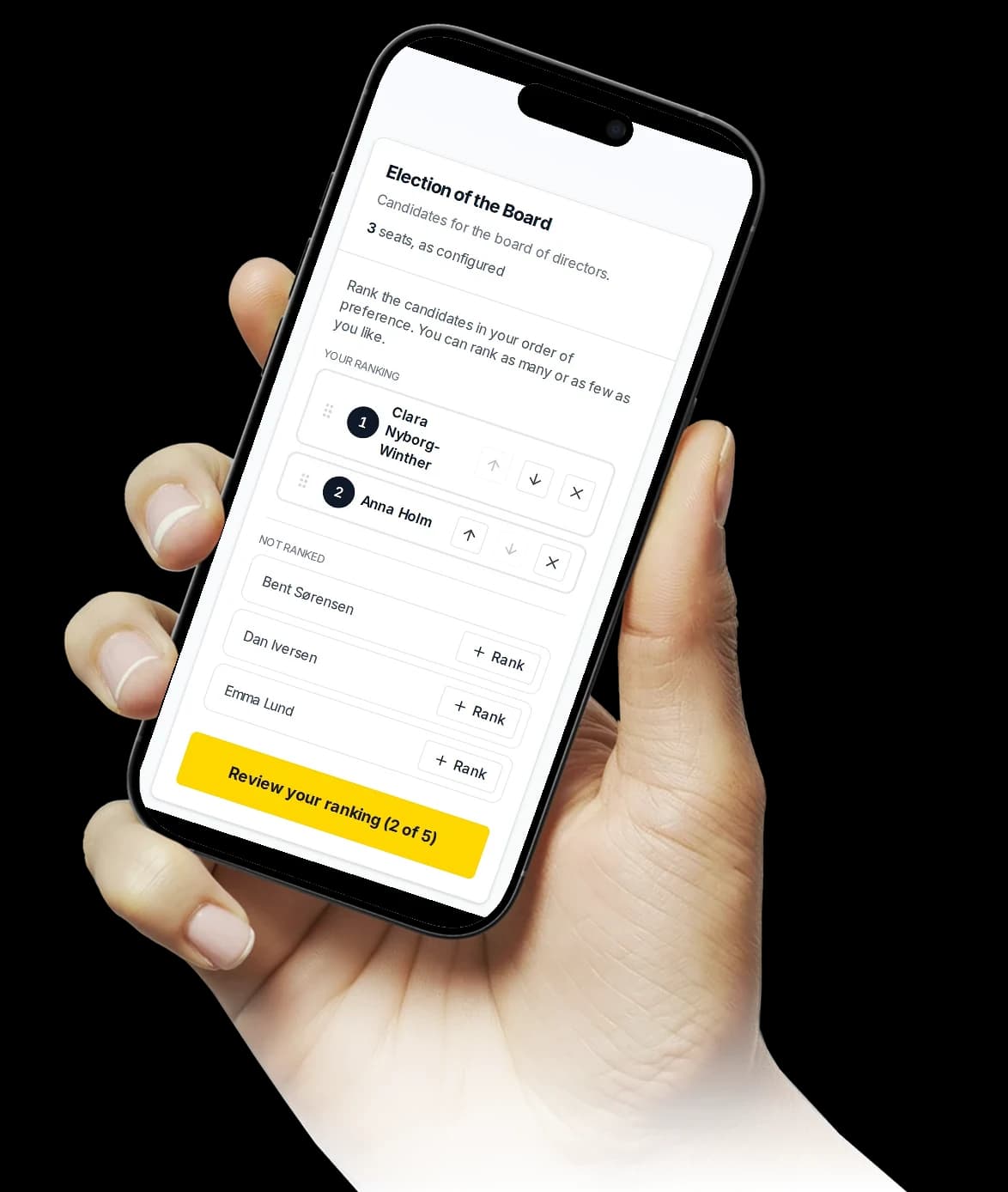
A board election by single transferable vote, shown round by round, so anyone can follow how each seat was filled.
A decision you can actually verify
Each outcome is kept with what it takes to understand it: what was asked, who took part, how it was counted and what the chair declared.
The meeting ends. The record remains.
We keep a meeting’s record for five years after it ends, as our data processing agreement sets out. The evidence package is yours to export and keep, and anyone holding it can check it at assembley.co/verify.
For organisations where decisions matter
Associations & federations
Member votes, elections and resolutions
Homeowner associations
Quorum tracking and weighted owner votes
Unions
Secret ballots members can verify
Education
Student council and faculty elections
Professional organisations
Board elections and AGMs
Any other organisation
Any vote that needs a record
One yearly plan, unlimited assemblies
Priced by the voters at your typical assembly, not your total membership. Prices exclude VAT.
Starter
Free
forever · up to 25 voters
Perfect for small clubs running their first digital assembly. No commitment, no credit card.
Get started free- Yes / No / Abstain voting
- Email invitations to members
- Live results & quorum tracking
- Minutes, ready to print and sign
- Cryptographic audit trail
- Virtual & in-person formats
- Not included: Secret ballots (per agenda item)
- Not included: Board elections
- Not included: Split voting
Basic
30-day free trial€149/ yr
from 30 voters
For associations that need the full governance toolkit: elections and secret ballots.
Start free trial- Everything in Starter
- Secret ballots (per agenda item)
- Board elections with candidates
- Multiple admin users
- Split voting Premium
Custom
Custom
unlimited voters
For large associations, federations, and organisations with 200+ members. We build a plan around your needs.
Contact us- Everything in Basic
- Unlimited voters
- Dedicated onboarding & training
- Priority support with SLA
- Fully negotiated contracts & DPA
Starter
€149/ yr
up to 10 shareholders
For small private companies needing a simple, compliant way to run shareholder meetings.
Get started- Yes / No / Abstain voting
- Secret ballots (per agenda item)
- Minutes, ready to print and sign
- Cryptographic audit trail
- Virtual & in-person formats
- Not included: Split voting
- Not included: Multiple share classes
- Not included: Proxy voting
Business
€299/ yr
from 15 shareholders
For companies that need the full governance toolkit: weighted voting, proxy delegation, and multiple share classes.
Get started- Everything in Starter
- Multiple share classes
- Proxy voting & delegation
- Multiple admin users
- Custom data agreement (DPA)
- Split voting Premium
Enterprise
Custom
unlimited shareholders
For listed companies, law firms managing multiple clients, and organisations with complex governance needs.
Book a demo- Everything in Business
- Unlimited shareholders
- Dedicated onboarding & training
- Negotiated contracts & DPA
- SLA guarantee
Frequently asked questions
The questions boards and administrators ask first. Every question is on the FAQ.
Does Danish law allow a general assembly to vote digitally?
Danish company law (Selskabsloven) and association law do not require votes to be cast in person or on paper. What they require is that votes are verifiable, that the person voting can be established, and that results are documented. Assembley records each of those things; whether a particular assembly was validly convened and held is for the organisation and its advisers to determine.
The evidence package is digital documentation of participation, voting rights and voting results, and cryptographically verifiable evidence of the recorded meeting data. What weight any particular record carries in a particular proceeding is for a court or a lawyer to determine, not for us to assert.
Danish law does not require in-person or paper voting. It requires verifiability, a record of who voted, and documentation. Assembley records all three.
What does the evidence package document, and how can it be verified?
The evidence package exported from every Assembley assembly contains a complete event log with timestamps and cryptographic hashes, individual vote records tied to verified identities on standard items (for secret-ballot items, participation and the ballot set without the individual choices), presence against the quorum figure you configured, Merkle root verification per agenda item, and a SHA-256 hash chain covering all events.
This package is a self-contained, tamper-evident record. If any event in the chain is modified after the assembly, the hash chain breaks at a detectable point, making tampering detectable at the first altered event. The chain is a SHA-256 hash chain, not a digital signature: it proves the recorded data has not been altered since it was written, and it does not attest to who signed anything.
Can a voter check their own secret ballot?
Yes. When a voter casts a secret ballot, their browser shows them a verification code to save. After voting closes, they can find that exact code in the published record and confirm their ballot was counted, without revealing how they voted.
The code is deliberately non-transferable: it cannot prove their choice to anyone else, so it gives a vote-buyer or someone applying pressure nothing to verify. Each voter can confirm their own ballot is in the count, while an outside auditor can verify the tally as a whole, with no identity revealed.
Can anyone, including Assembley, alter a submitted vote?
No. Votes are append-only, enforced at the PostgreSQL database level by a trigger that blocks every DELETE on the votes table, and every UPDATE except removing the voter's name after an erasure request or at the end of retention. This applies to all database users, including Assembley administrators. It is not a policy control. It is an architectural constraint that cannot be bypassed by application code.
Additionally, every vote is included in a SHA-256 hash chain. Any modification to any vote record would break the chain at a detectable point. The Merkle root for each agenda item is stored separately and can be used to verify the integrity of the vote set independently, without access to Assembley systems.
Votes are append-only, enforced at the database level by a PostgreSQL trigger, not by access controls or policy. No user, including Assembley, can change a submitted choice or delete a vote.
What do voters need to participate?
Voters need only an email address and a device with a web browser. There is no app to download, no account to create, and no password to remember. Each voter receives a unique, single-use ballot link by email. The link opens their ballot, and in an invited meeting they also enter the meeting code the chair shows during the meeting.
Each link works once and expires 24 hours after the scheduled meeting time, or 7 days after sending if no time is set. Every invitation email includes a short “How to vote” section for voters who are less at home with technology.